





 +60173309581
Two APU students won Build Week Hackathon 2026 with Agent Escrow, a live Web3 solution enabling secure AI-agent transactions worldwide.
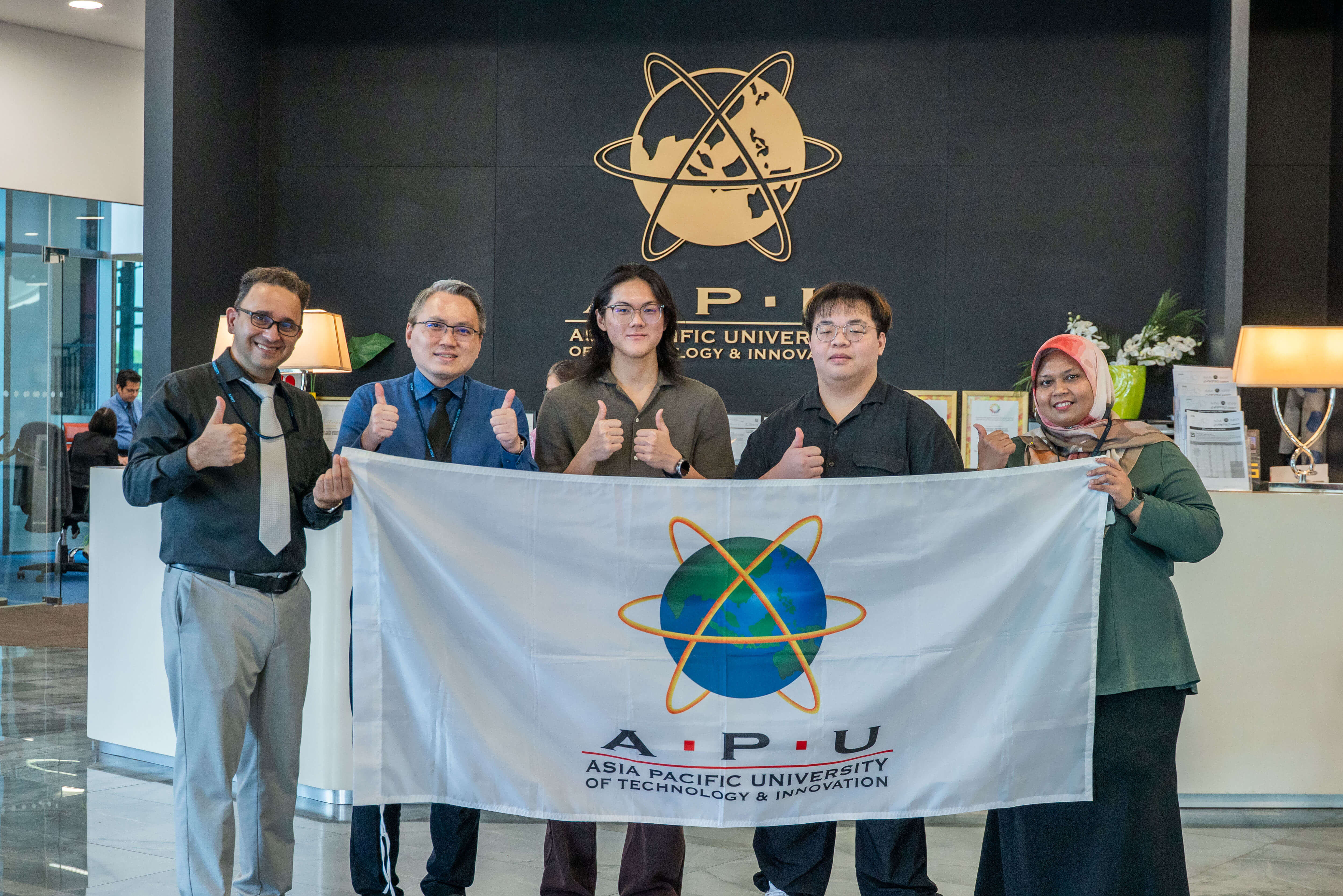
A two-member student team from Asia Pacific University of Technology & Innovation (APU) has emerged as champion of the Build Week Hackathon 2026, showing how student innovation can progress beyond competition into a solution with real-world potential.
Team “67 on the merry rizzmas”, comprising Chan Hao Wen and Tong Yi Xin, secured First Place and a USD 150 cash prize with “Agent Escrow”, a Web3 application designed to enable secure, decentralised payments for work carried out by AI agents.
The hackathon, co-organised by Girl Meets Tech and On Chain Consultancy, ran from 15 July to 6 August 2026 and welcomed participants globally. More than 100 registered, with over 40 builders producing more than 30 project submissions.
Although open to beginners, experienced developers, AI-tool users and “vibe coders”, every entrant had to deploy a working smart contract on BOT Chain.
Building Trust into the AI Agent Economy
Led by Hao Wen, a Diploma in Information & Communication Technology student specialising in Software Engineering, together with Yi Xin, a Bachelor of Science (Honours) in Computer Science (Cyber Security) student, the team set out to solve a practical problem in the emerging AI agent economy.
As AI agents increasingly perform tasks on behalf of users, one agent or human operator may hire another agent for paid work. Yet ensuring payment is released fairly after delivery can be difficult without a trusted mechanism.
Agent Escrow addresses this gap through a smart contract that holds BOT tokens in escrow. A requester can lock funds for a designated agent while setting a work deadline and review period. The agent must accept the assignment and submit proof of delivery before the deadline.
Once the work is completed, the requester may release payment immediately. If no action is taken before the review period ends, the smart contract automatically transfers the funds to the agent. If the deadline is missed, the requester can reclaim the locked funds.
The system requires no intermediary, backend server or administrator with special control. Every stage — creation, acceptance, submission, release, refund or cancellation — is enforced by the smart contract and publicly verifiable on-chain.
Technical Depth Judges Could Verify
Supervised by Mr Shahab Alizadeh, Senior Lecturer in Cyber Security & Forensics at APU’s School of Technology (SoT), the team demonstrated full-stack blockchain capability, from Solidity smart contract design to a deployed and verified production frontend.
Its security features included reentrancy-guarded fund transfers and checks-effects-interactions ordering, addressing known smart-contract vulnerabilities associated with real financial losses. The team also implemented a deadline-bound state machine and an on-chain reputation system to strengthen trust and accountability.
What further differentiated Agent Escrow was its ability to move real value between two independent wallets, rather than relying on a single-user demonstration. This end-to-end implementation showed how blockchain could support genuine transactions between independent parties.
Judges applied a fixed rubric: 35% for smart contract deployment, 30% for end-to-end functionality, 20% for originality and use-case clarity, and 15% for social media visibility, presentation and demonstration.
Beyond the Competition
Agent Escrow secured First Place, ahead of Velora from Digital Technology University of Indonesia and Trust Ticket from Universiti Malaysia Pahang Al-Sultan Abdullah.
The project remains live and publicly accessible after the hackathon at www.agent-escrow.online, reflecting the team’s intention to create something useful beyond the judging stage.
“Winning this with Tong Yi Xin means a lot, especially as it was both our first international hackathon and his first hackathon overall. Representing APU on an international stage against teams worldwide was incredibly rewarding,” said Hao Wen.
“Agent Escrow gave me valuable hands-on experience in smart contract security and blockchain development beyond coursework, strengthening the self-driven learning I hope to carry into my career,” he added.
Mentorship Beyond the Classroom
Mr Shahab said, “As a mentor, I am immensely proud of Hao Wen and Yi Xin for demonstrating APU students’ ability to compete and succeed internationally. Their achievement reflects technical capability, determination and learning beyond the classroom.
“The hackathon also provided valuable exposure to real-world problem-solving, teamwork, blockchain and smart contract security, strengthening their confidence and skills.”
Assoc Prof Dr Thang Ka Fei, Senior Head of SoT, concluded, “This achievement reflects how APU students transform advanced knowledge into practical innovation, while developing confidence, resilience and industry-ready capabilities to create meaningful solutions for an increasingly intelligent, decentralised digital future.”