





 +60173309581
Didn’t Get Medicine? 6 Health Science Courses in Malaysia Worth Considering
October 20, 2026
Mehmil

Didn’t get a place in medicine? Take a breath.
You’ve worked hard for a career in healthcare. Maybe a medicine offer didn’t come through, or fees, competition, or entry requirements put it out of reach.
Now you’re wondering whether to try again, change direction, or look at studying abroad.
Malaysia is worth a serious look. Pharmacy, dentistry, nursing, physiotherapy, biomedical science and medical laboratory technology are all offered at universities approved by the MQA (Malaysian Qualifications Agency), and many are taught in English.
But before you book a flight, you need to know something most brochures skip: studying a health course in Malaysia and being allowed to practise afterwards are two different things. The rules depend on the profession and your nationality.
Here’s what each course involves, what it costs, and what really happens after you graduate, so you can choose with your eyes open.
Health Science Courses in Malaysia
| Course | Typical Length | Main Regulator | Approx. Tuition for International Students* |
|---|---|---|---|
| Pharmacy | 4 years | Pharmacy Board Malaysia | RM 140,000 to RM 230,000 |
| Dentistry | 5 years | Malaysian Dental Council | RM 250,000 to RM 380,000+ |
| Nursing | 4 years | Malaysian Nursing Board | RM 80,000 to RM 155,000 |
| Physiotherapy | 4 years | Malaysian Allied Health Professions Council (MAHPC) | RM 80,000 to RM 120,000 |
| Biomedical Science | 3 to 4 years | MAHPC (for lab scientist roles) | RM 55,000 to RM 165,000 |
| Medical Laboratory Technology | 3 years (diploma) | MAHPC | About RM 60,000 in total |
Approximate ranges that vary by university. Excludes living costs, visa, and insurance.
Physiotherapy is a regulated profession under Malaysia’s Allied Health Professions Act 2016, which came into operation on 1 July 2020. The same Act covers medical laboratory technologists, dietitians, and around 20 other allied health professions.
1. Pharmacy: Is it a good course in Malaysia?
A science-driven path for students who combine strong chemistry skills with clear communication.
Yes, for students who enjoy science and can communicate clearly. Pharmacists work in hospitals, community pharmacies, regulatory bodies, and the pharmaceutical industry.
What you’ll study: How medicines work, how they are formulated and manufactured, and how to advise patients on their safe use, with placements in community and hospital settings.
Duration and entry: Four years. Universities typically accept A-Levels, the IB, a science foundation programme, or a diploma in pharmacy, with strong results in chemistry. Some institutions also hold a pre-admission interview.
Where it leads: Hospital and community pharmacy, regulatory affairs, clinical research, and the pharmaceutical industry.
Also Read: Is Studying Pharmacy in Malaysia Worth It?
Registering as a pharmacist in Malaysia is mainly for Malaysian citizens and permanent residents. If you plan to practise in your home country, confirm that your home regulator recognises the degree before you enrol.
2. Dentistry: the closest alternative, with its own tough entry
A rigorous, clinically intensive path for students who want a career in oral healthcare.
Dentistry in Malaysia is not a fallback option. Admission is competitive, and the training is demanding, so it is best viewed as a distinct pathway in its own right.
What you’ll study: Foundational biomedical sciences, followed by simulation laboratory training and supervised patient treatment in the clinical years.
Duration and entry: Five years. Applicants are typically expected to have strong results in biology, chemistry, and physics or mathematics, and may be required to complete a health screening.
Career pathways: General dental practice, with the option to pursue specialist training.
Full dental registration in Malaysia is generally for citizens and permanent residents. Non-citizens who are already registered as dentists overseas can apply for a Temporary Practising Certificate (valid for up to 12 months). Confirm your registration route with the Malaysian Dental Council before enrolling.
3. Nursing: Is the degree worth it in Malaysia?
A people-centred profession for students who stay composed under pressure.
Yes, for students who want a career with international potential. Nurses are needed in healthcare systems worldwide, and a bachelor’s degree generally offers broader career options than a diploma.
What you’ll study: Foundations of nursing, followed by medical-surgical, paediatric, mental health and community nursing, with supervised clinical placements.
Duration and entry: Four years for the degree. Applicants typically need pre-university or diploma results that include science and mathematics. Some universities list IELTS 5.5 as a minimum English requirement, so check each institution’s criteria.
Career pathways: Hospital nursing, specialist care, education and management.
Foreign-trained nurses seeking work in Malaysia may be issued a Temporary Practising Certificate by the Nursing Board, subject to its criteria and quotas. If you plan to practise elsewhere, confirm that the qualification is recognised by your home regulator before enrolling.
4. Physiotherapy: for students who want to restore movement and function
A hands-on, rehabilitation-focused path for students motivated by patient recovery.
Physiotherapy suits students who want to see the direct impact of their work on patients’ mobility and quality of life. It is a regulated allied health profession in Malaysia.
What you’ll study: Anatomy, exercise science and rehabilitation, followed by supervised clinical practice across musculoskeletal, neurological, cardiorespiratory, paediatric and sports settings.
Duration and entry: Four years. Applicants typically need science-focused pre-university results. Several universities list IELTS 5.5 or equivalent as the minimum English requirement.
Career pathways: Hospital rehabilitation, sports clinics, elderly care and private practice.
Physiotherapists are regulated by the Malaysian Allied Health Professions Council (MAHPC). The Allied Health Professions Act provides for a Temporary Practising Certificate for non-Malaysian practitioners, but registration requirements vary by case. Confirm recognition with your home regulator before enrolling.
5. Biomedical Science: the flexible pathway
A research-oriented path for students interested in understanding disease at the scientific level.
Biomedical science focuses less on treating patients and more on investigating how disease works, which makes it one of the more versatile options in this list.
What you’ll study: Biochemistry, microbiology, genetics, immunology, haematology and laboratory techniques, often including a hospital or research placement.
Duration and entry: Three to four years, depending on the university. Applicants typically need A-Levels, the IB or a science foundation programme. Several programmes list IELTS 5.5 as the minimum English requirement.
Career pathways: Research, diagnostics, biotechnology, the pharmaceutical industry and postgraduate study.
The Ministry of Health’s 2022 amendment merged several laboratory science titles into one profession, so job titles you see online may not match the official professional categories.
6. Medical Laboratory Technology: the behind-the-scenes pathway
A precise, laboratory-based path for students who want to support accurate diagnosis.
Medical laboratory technologists perform the tests that clinicians rely on to diagnose and monitor disease. The course is mostly offered at diploma level, so it is not a bachelor’s degree. One route to degree-level study is biomedical science.
What you’ll study: Bacteriology, haematology, histology and clinical chemistry, with placements in hospital and diagnostic laboratories (12 to 28 weeks at some colleges).
Duration and entry: Three years. Entry is often at secondary school-leaver level. Some colleges ask for around 11 years of schooling and a pass in a secondary certificate, though requirements vary by institution.
Career pathways: Hospital and private diagnostic laboratories, blood banks, research support, or progression to a degree.
Medical laboratory technologists are regulated under the Allied Health Professions Act. Always confirm your degree recognition with your home regulator before enrolling.
For International Students: What to know before you apply
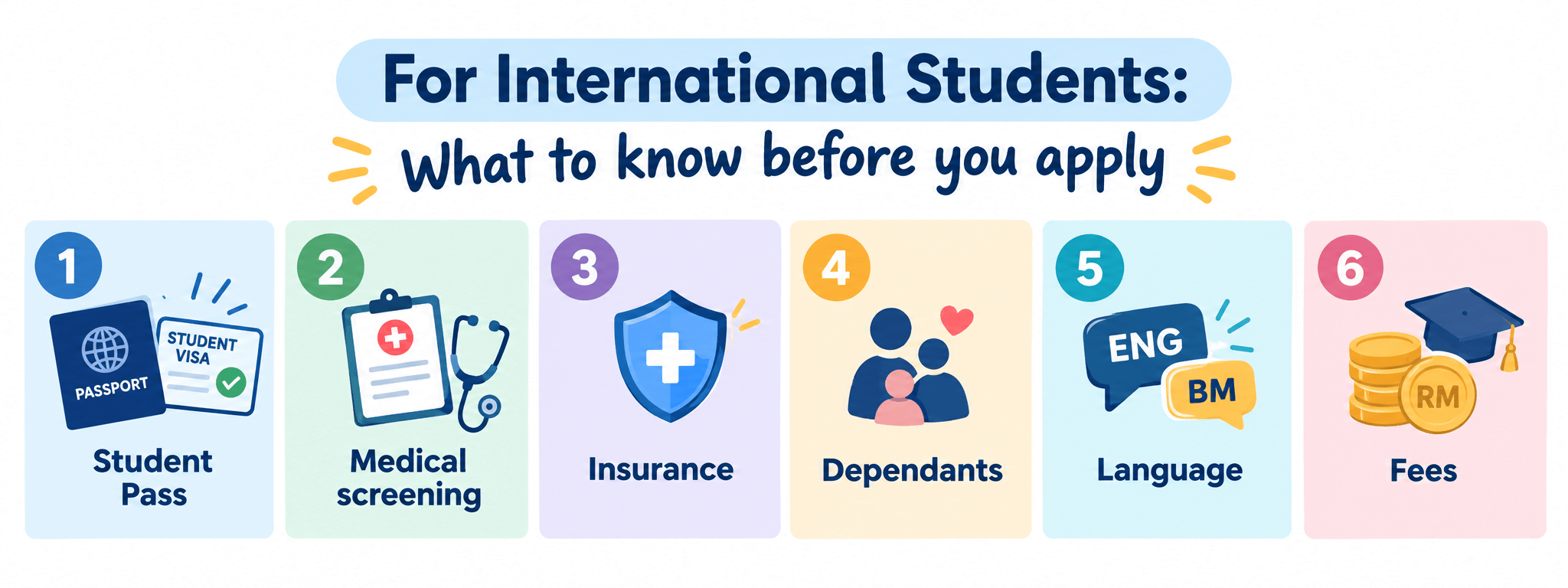
1. Student Pass: Connect with Easyuni to help to choose university & course. Your student visa is applied through EMGS (Education Malaysia Global Services) by your university. You’re approved before you travel.
2. Medical screening: New international students attend a screening at a panel clinic within 7 working days of arriving.
3. Insurance: You need a health insurance policy recognised in Malaysia, covering at least 12 months.
4. Dependants: Only master’s and PhD students may bring dependants.
5. Language: Teaching is mainly in English. Many universities add a Bahasa Melayu module for international students.
6. Fees: Quoted in Malaysian ringgit (RM) and usually higher than local fees. Budget for admin, exam and visa costs on top of tuition.
Which Course Suits You? Three quick questions
Do you want to work directly with patients? Nursing, dentistry and physiotherapy say yes. Biomedical science and lab technology say mostly no.
People or puzzles? If you love talking to patients, lean towards clinical roles. If you love data and discovery, lean towards labs and research.
Where will you practise? This decides everything for pharmacy, dentistry and nursing. Check your home country’s regulator first.
FAQ: Health Science Courses in Malaysia for International Students
1. Can international students study health science in Malaysia?
Yes. International students can study health science courses in Malaysia at MQA-approved universities, with a Student Pass arranged through EMGS (Education Malaysia Global Services). Many programmes are taught in English.
2. What can I study in Malaysia if I don’t get into medicine?
The main alternatives to medicine in Malaysia are pharmacy, dentistry, nursing, physiotherapy, biomedical science and medical laboratory technology. Most are offered at MQA-accredited universities and colleges.
3. Can international students register to practise in Malaysia after graduating?
It depends on your profession and nationality. Full registration in pharmacy and dentistry is generally for Malaysian citizens and permanent residents, while temporary practising certificates exist for some non-citizens. Always confirm with the relevant regulator before you enrol.
4. Which health science course is the cheapest in Malaysia?
Medical laboratory technology (a diploma) and some biomedical science programmes have the lowest tuition for international students. Dentistry is the most expensive. Fees vary by university, so compare total costs & get free guidance from Easyuni.
5. Which health course has the best job prospects in Malaysia?
It depends on where you plan to work and whether your degree is recognised there. Registration rules differ by profession and nationality, so check your home country’s requirements first.
Your next steps
Missing out on medicine isn’t the end of your health career. It could be the start of a better-fitting one. Shortlist two or three health science courses, check each programme’s MQA accreditation and professional body recognition, and compare total costs.
Disclaimer: Entry requirements, fees, registration rules and visa conditions change often.
🎓 Questions About Fees, Intakes or Your Student Pass?
Speak to an EasyUni study advisor today for help finding the right health science course in Malaysia, from pharmacy and nursing to biomedical science.
📞 Speak to UsKickstart your education in Malaysia
We'll help you find and apply for your dream university
You might be interested in...
- Top Actuarial Science Universities in Malaysia for International Students 2026
- Is an MBA Worth It? 5 Pros and Cons You Should Consider in 2026
- Choosing the right university and course in Malaysia
- Types of English Language Proficiency Tests in Malaysia
- Choosing Between Public or Private University in Malaysia: What is your choice?
- Language Barrier Between International And Local Students
- How University Students Should Prepare For Work?
- Living Cost in Malaysia for International Students 2026
- How Can International Students Work in Malaysia After Graduation
- Semester Break Exploration Guide For International Students in Malaysia